

Summary
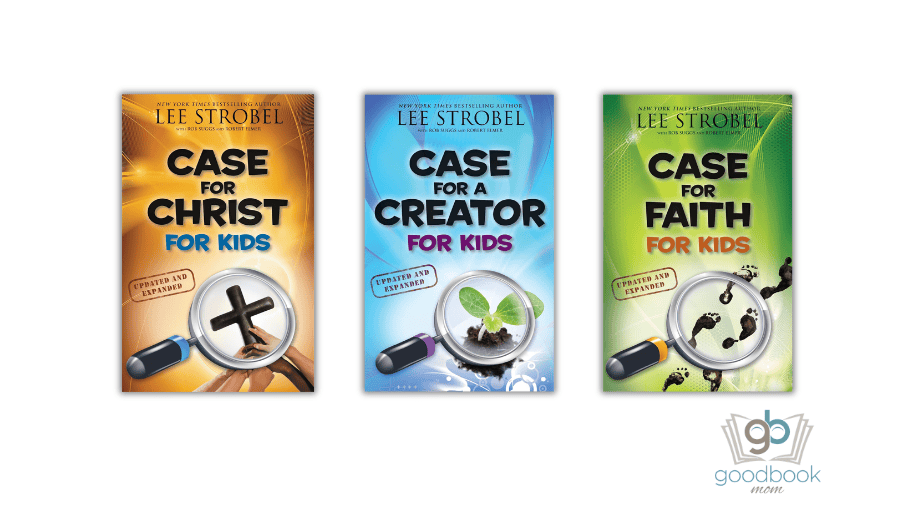
The Case for Christ for Kids series (including Case for Christ for Kids, Case for Faith for Kids, and Case for a Creator for Kids) provide foundations in apologetics for upper elementary students. Each book is divided into two sections: the first part includes questions children may have about each topic, and the second section includes four stories aimed to help children apply what they have learned.
Case for Christ for Kids helps children think about three main questions: Who is Jesus? Can we believe what the Bible says about Him? Did he truly rise from the dead? Strobel uses illustrations, definitions, reflection questions, and Bible verses to help children work through these questions.
Case for Faith for Kids follows a similar pattern of presenting illustrations, questions, Bible verses, definitions, and examples to help children grapple with the hard questions skeptics might present them about their faith. Strobel addresses four questions: Why would a good God allow bad things to happen? Do all religions lead to heaven? Does science disprove miracles? Is it okay to have doubts about faith and still be a Christian?
Finally, Case for a Creator for Kids, while following the same format, focuses the most on extra-Biblical arguments and logic to help children think about what evidence from creation points to a creator. The book asks children to consider whether science is always pitted against religion, or if they can work together. This book focuses on gathering information through objectivity to come to conclusions and see how science and the Bible point to God as Creator of the universe.
Reading Level: Ages 8-11
Read Aloud Age: 6+
Mom Thoughts
Based on the original Case for Christ books for adults, this series aims to help children investigate the claims of Christianity for themselves. As an adult reading this book, I was familiar with the presented arguments and was eager to see how Strobel explained them in a child-friendly way. I appreciate the definitions of key terms interspersed throughout the books along with the reflection questions scattered throughout the chapters to help children and the adults reading with them to think about what they have been reading. While these books provide a starting point for helping children think about apologetics and begin to grapple with doubts and arguments towards Christianity, I felt that there were a number of concerns with Case for Christ for Kids and Case for Faith for Kids in particular.
In Case for Christ for Kids, some of the illustrations in this book are quite dated. The author discusses how we might be reading tabloids and the newspapers and need to consider the trustworthiness of the sources. While the point is valid, in an age inundated with information, families may want to discuss sources of information to a greater extent considering news on the internet, social media, etc. The usage of Bible translations in this book, however, is perhaps its greatest fault. First, when making a point about whether or not the Bible gives evidence of Jesus acting like a crazy person, Strobel quotes The Message as his textual evidence. While a Biblical paraphrase can be helpful, if we believe children can think through apologetic arguments for their faith, then certainly they can handle a proper translation of the Bible; a paraphrase doesn’t stand as robust textual evidence. In addition, when talking about Thomas’s doubts in the Gospel of John, the New Century Version is used, stating, “Those who believe without seeing me will be truly happy.” This translation replaces blessed with ‘truly happy,’ potentially losing some theological depth. Parents may want to have another Bible translation alongside them in order to look up the quoted Bible passages and discuss them.
Case for Faith for Kids is the weakest of the three books. While the questions Strobel asks are all valid ones that even mature adult believers struggle with, many of the quoted Bible passages are misapplied and taken out of context. Firstly, the author explains Jeremiah 29:13 by saying that we need to seek God with all our effort. Written specifically to the exiles in Babylon, Jeremiah 29 is a frequently misapplied chapter. Also, the author’s explanation of using our ‘best efforts’ to seek after God sounds borderline works based. In addition, Strobel offers deficient explanations regarding Genesis 3 and Romans 8. When explaining suffering in relation to Genesis 3:17 and the curse of the ground, the author states: “through poor choices people and the world were damaged.” This explanation of the Fall seems overly simplistic. Disobedience is more than a poor choice- it is the ultimate rebellion against a holy God. The explanation of suffering with Romans 8:28 is also lacking. A verse that is often misapplied, Strobel explains that this verse shows how evil is an opportunity to make something good out of a tough situation; in other words, God will bring something good out of evil and hard things for his followers. Whilst there is truth that God is bringing about good through his ultimate purposes to bring everything under Christ, the examples in this section are all focused on the present. There is no mention that sometimes the good God is working out may not be seen until the New Creation.
A final misapplied Bible verse is Revelation 3:30. While the verse of Jesus standing at the door knocking is often taken out of context, it is a verse in a specific letter to the church in Laodicea. Rather than looking at the contextual meaning, Strobel explains that Jesus expects that we should listen to this knocking in our everyday lives. Another potential area of concern in this book is found in the section where the author asks children to contemplate whether they tend to think more of God’s power or his love. Whilst the question attempts to help children analyze where their views of God may be incorrect, it could slightly be confusing for younger children without explanation that we shouldn’t pit God’s attributes against one another. It would be helpful for a parent to read this alongside their child and help them see that we might overly emphasize God’s love at the expense of another attribute and this is a problem because God is 100% of his attributes all of the time. Finally, Case for Faith for Kids relies heavily on an imaginary discussion between the narrator and Ravi Zacharias. In light of revelations against Zacharias, this section should be read with caution and parental direction.
The final book in this set, Case for Creation for Kids, is perhaps the best of the three. The book focuses primarily on logic and reasoning and would serve as a helpful tool for elementary aged students to begin building the foundations on what comprises a logical argument. The strength of the book is in its emphasis that religion and science are not at odds with one another and scientific evidence and experimentation can build a solid argument for the case of the creation of the world. Despite its utility, there are a few areas of consideration in the book. Firstly, much emphasis is given to the Kalam Cosmological Argument to help children understand the case for creation. Recently repopularised by William Lane Craig, the logic of this argument is helpful and the premises and deductions behind it are simple for young learners to understand. However, the author briefly mentions that this argument was originally proposed by Muslim philosophers (the name Kalam is from a Medieval Muslim scholar). While the logic of the Kalam Cosmological Argument is valid, parents may want to be aware of this passing comment and potentially discuss with their children. My own child asked how we could use an argument from a Muslim to prove the case of the Christian God, so there is some potential for confusion. The one other area of caution is in the final faith experiment. Strobel asks children to experiment with their faith and ask God to speak to their hearts. There is nothing inherently wrong with asking God to speak to their hearts, but God speaking to us could potentially be open to interpretation. Furthermore, God speaking to our children isn’t the same as conducting a science project and should be done through reading His word in order to get to know him better.
Language:
Instances of the words: ‘freak, dude, dummy, weird, fat.’ Often these are used in name-calling in the case study sections of the book. These sections also include some children responding in inappropriate ways through phrases such as ‘hate, chill out, whatever, knock it off.’
An example in Case for Christ uses the word ‘dirty’ to refer to children and families in a high poverty area. The word ‘crazy’ is also used to help children analyze the claims of Jesus and is repeated multiple times. (Similar to C.S. Lewis’s question of whether Jesus is a liar, lunatic, or Lord).
Case for Creation makes a reference to HBO Television.
Questionable Behaviors:
Most of the questionable behaviors are found in the case studies sections in each book. These are not celebrated and are usually used in examples of how children might experience opposition or differing ideas to their faith.
Some children in the case studies make fun of others, egg each other on, or bully others. Some children in the case studies disobey authority figures. One example includes children trying to scam their way into a movie theater and not pay for their tickets. There is also an example including parent and children aggression over a youth soccer match.
Case for Christ includes a visual illustration of a mummy in a graveyard when discussing how we know whether or not Jesus truly came back from the dead.
This review is written by Good Book Mom contributor, Elizabeth Tso. To learn more about Elizabeth, click HERE.
This post may contain affiliate links. Please read our disclaimer for more info.
Buy These Books
At A Glance
| Number of Pages | Number of Chapters |
|---|---|
| about 150/book | about 12/book |