This week, the ALA and other organizations celebrate “Banned Books Week.” According to the ALA, “Banned Books Week launched in 1982 in response to a sudden surge in the number of book challenges in libraries, schools, and bookstores.”
What is a book challenge?
When a patron feels that a book should be removed from the library OR that a book should be moved to a different section of the library (for example, from Juvenile Fiction to Adult Fiction) this is considered a “challenge.” Keep in mind that a challenge does not mean the request was successful, simply that it was made.
This is where the deception begins.
Deception #1- The title of “Banned Books”
Book challenges often don’t succeed. When they do, the books are usually relocated or reclassified in a different section, not removed from the library or “banned.” I understand that “Challenged Book Week” doesn’t have the same ring to it, but that’s actually what this week is about: challenged books.
Which brings me to the second deception.
Deception #2- These “Banned Books” are hard to access, so we need to fight for them
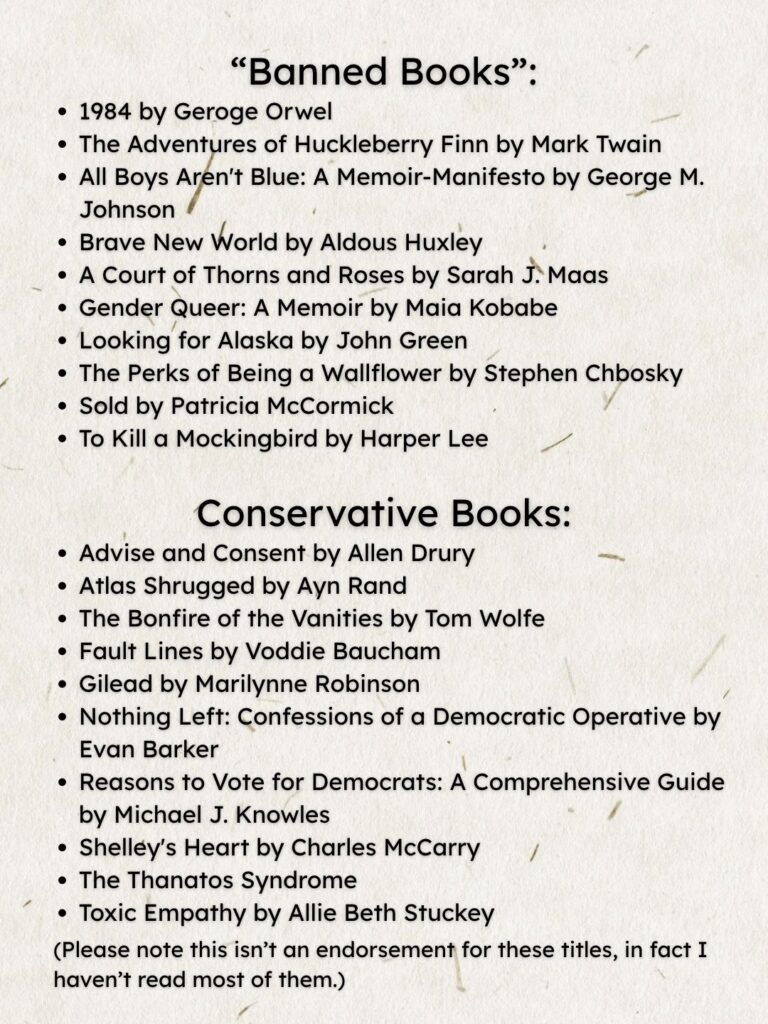
The reality is, the titles that top the “Banned Books” list are often the most easily accessible titles in public libraries. I checked the libraries of two very conservative cities in the U.S.: Mesa, AZ and Oklahoma City, OK. I looked for 6 modern “Banned Books” and 4 “Classic Banned Books” to see if they were available. All 10 were available in both systems.
Obviously, this doesn’t mean all “Banned Books” will be on the shelf in every library. However, the flip side of this story often goes untold.
Deception #3- The ALA (and many librarians) want you to have easy access to all books
There are some really great librarians. I want to make that perfectly clear. However, the reality is that some books are never challenged because they are never purchased by librarians in the first place.
Librarians may think of themselves as protectors of free speech, but the truth is that they are the ones deciding what to purchase for the library, and what not to purchase. Censorship on some level is completely unavoidable because every library cannot contain every book. Librarians have to curate their collection. A good library should reflect its community, but in reality, many times it reflects the librarians.
This is the silent book banning that isn’t being talked about enough. Silenced Books are never (or rarely) purchased. So, I did some digging.
I searched the catalogs of 15 US library systems, mostly large and a few small, to see the availability of 10 “Banned Books” (lists at the end). I also searched for 10 titles that are written by conservatives, a mix of fiction and non-fiction, some modern and some a bit older (to reflect the “Banned Books” list) to see how many would be available in the same library systems.
At first, I was surprised that most liberal systems contained many of the conservative titles. Then I started comparing numbers.
A title that has been (rightly) controversial and challenged is New York Times Best Seller, All Boys Aren’t Blue: A Memoir-Manifesto by George M. Johnson. I have read some of the passages from this title and they are terribly sexually graphic. Please do not read it. It’s often located in the YA (Young Adult ages 13-18) section. The Los Angeles Public Library System has 73 locations and carries 45 copies of this book.
Conversely, it carries 2 copies of the unabashedly conservative New York Times Best Seller, Toxic Empathy by Allie Beth Stuckey and 4 copies of the Anit-Social Justice Movement title and USA Today’s Best Seller, Fault Lines by Voddie Baucham. 45 copies versus 2. Who is truly being silenced?
Similarly, The New York Public Library System (NYPL) has 92 locations and carries 63 copies of All Boys Aren’t Blue: A Memoir-Manifesto, while only 4 copies of Toxic Empathy and 0 physical copies of Fault Lines, with an ebook available. The trend continued with the liberal systems I checked. Many copies of “Banned Books” were available, oftentimes at every location, while the books from conservative viewpoints were in the system but at a fraction of the availability.
This is censorship. And it’s happening silently.
If just as many copies of Toxic Empathy or Fault Lines appeared in the Los Angeles Public Library System, they might be challenged. Would then the ALA rally behind these titles and celebrate them as “Banned Books”? My honest thoughts are that if a patron complained, many librarians would silently pull these titles and not escalate it to a challenge, so it’s never reported. Challenging a book isn’t something that liberals want to be caught doing, but expressing dislike and then having a book disappear from the shelves…? Maybe that’s only censorship when it comes from a certain demographic.
The large systems carry enough conservative titles to not be labeled “censoring” while making sure they aren’t readily available and able to be stumbled upon by most patrons. They are actively violating the ALA’s Statement on Book Censorship:
“Libraries manifest the promises of the First Amendment by making available the widest possible range of viewpoints, opinions, and ideas, so that every person has the opportunity to freely read and consider information and ideas regardless of their content or the viewpoint of the author*.”
As I stated, a library should reflect its community, so it’s not surprising to find more liberal titles in liberal cities, but the lopsidedness in liberal cities makes “Widest possible range of viewpoints…” virtually impossible.
If you’re wondering about the more conservative systems I checked, Mesa, AZ (4 locations) had 4 copies of All Boys Aren’t Blue, 2 copies of Toxic Empathy, and an ebook of Fault Lines. Metropolitan Library System (Oklahoma City, 19 locations) had 3 copies of All Boys Aren’t Blue, 2 copies of Toxic Empathy, and 3 copies of Fault Lines. The other conservative systems followed a shockingly more balanced suit.
I am aware this is an incredibly small sampling of mostly large library systems, which is why I want you to check your public library. See what the balance is like. Are there just enough titles from conservatives that they can be brought out of hiding when they are explicitly sought out? Or, as the ALA itself says, “People looking for that book will assume the library doesn’t have it. Those whom the book has relevance for won’t stumble upon it while browsing the shelves*.” That brings me to the last deception of “Banned Books Week.”
Deception #4- All Censorship is Bad
I know that every library cannot contain every book. You know that. It’s silly to think otherwise. However, as soon as a book is not included because of discernment, it’s labeled negatively as censorship. I appreciate and think it absolutely necessary that we have laws against minors purchasing porn. This is good censorship. (As a Christian I am absolutely against porn for any age.) I appreciate that children under 17 cannot see R rated movies in a theater without an adult. This is good censorship. The “R” literally means “Restricted,” as in they are restricting (limiting or censoring) who can see that movie. If you watch live TV, certain words are bleeped out to avoid an amount of indecency and profanity. This is good censorship. In fact, many argue that censorship here is too lax.
But somehow, when it comes to books, any censorship–even obviously appropriate discernment that protects children from profanity and indecency–has been demonized. I do not want any child to be able to walk into the juvenile or young adult section of a library and pick up a book that has this kind of content. That would be good censorship, not “stripping minors of their rights.”
If someone tried to read the explicit sections of All Boys Aren’t Blue on live TV, there is no way it would make it past the FCC. If someone made a movie version of All Boys Aren’t Blue, depending on how it’s portrayed, it would certainly have an R rating, if not NC-17. And yet in written form, these same ideas are protected and even championed for children. Forsaking common sense protection of children is not the evil, rights abandoning action it’s portrayed as, in very short, because we see it easily enforced in other spaces.
So, what can we do about it as Christians? First, (and this one makes some people mad) form genuine relationships with your librarians. Pray for them. Care about them. If all believers who used their local public libraries took the time to connect with and intentionally pray for their librarians, the results would be greater than we can imagine. Even if you have radically different worldviews, view them as the Image Bearers they are, and remind yourself that “we do not wrestle against flesh and blood, but against the rulers, against the authorities, against the cosmic powers over this present darkness, against the spiritual forces of evil in the heavenly places.” Ephesians 6:12
Second, peruse your library’s catalog and see if things are unbalanced. Search for Silenced Books. If your library offers patron requests- take advantage of this. Request wonderful titles to be carried at your library. If they do not take patron requests, have a conversation with a librarian (you know, the one with whom you now have a relationship). Talk to them as a human being, not your enemy.
If you don’t get anywhere with your librarian, find a few other people who have similar concerns and attend a library board meeting to respectfully express those concerns. Read through the ALA’s Statement on Book Censorship , explore the ALA’s Censorship Portal (including the FAQs at the bottom), and know your library’s catalog well. Also, see how to get on your public library board. It may be easier than you think. Pray. Do what’s in your power for the glory of the Lord, and then leave it in His hands.
“So, whether you eat or drink, or whatever you do, do all to the glory of God.” 1 Corinthians 10:31
Korrie Johnson, Founder of Good Book Mom
Update: 10/17/2026
After responding to some comments and DMs, I thought it would be helpful to gather some more data and make some clarifying statements.
First. the original post was never intended to imply that you are helpless to change anything at your public library. I talk so much at Good Book Mom about Christians getting into their public libraries. I’ve even had my Public Library Mini-Course available for free for a few years now because I know things like forming real relationships, checkouts, and requests are real ways to impact the library. I assumed people would know this is my stance, since I’ve been talking about it for years, but some did not know.
It is also true that some library systems, no matter how Christians try to get involved or voice their desires, do not make allowance for them in their catalog. It’s easy to think that all libraries are run and function pretty much the same way, and while there are obviously commonalities, the more I learn, the more I see how each system has its own quirks. Just because your library values the opinion and input of its minority (or even majority) patrons, doesn’t mean every system does. I field messages all the time with frustrated believers expressing this very thing.
A few people commented that my comparison books were too different to use against each other. I chose them because they were non-fiction and best sellers, but they did have enough differences that I thought the critique was valid and wanted to do better. So I did more digging.
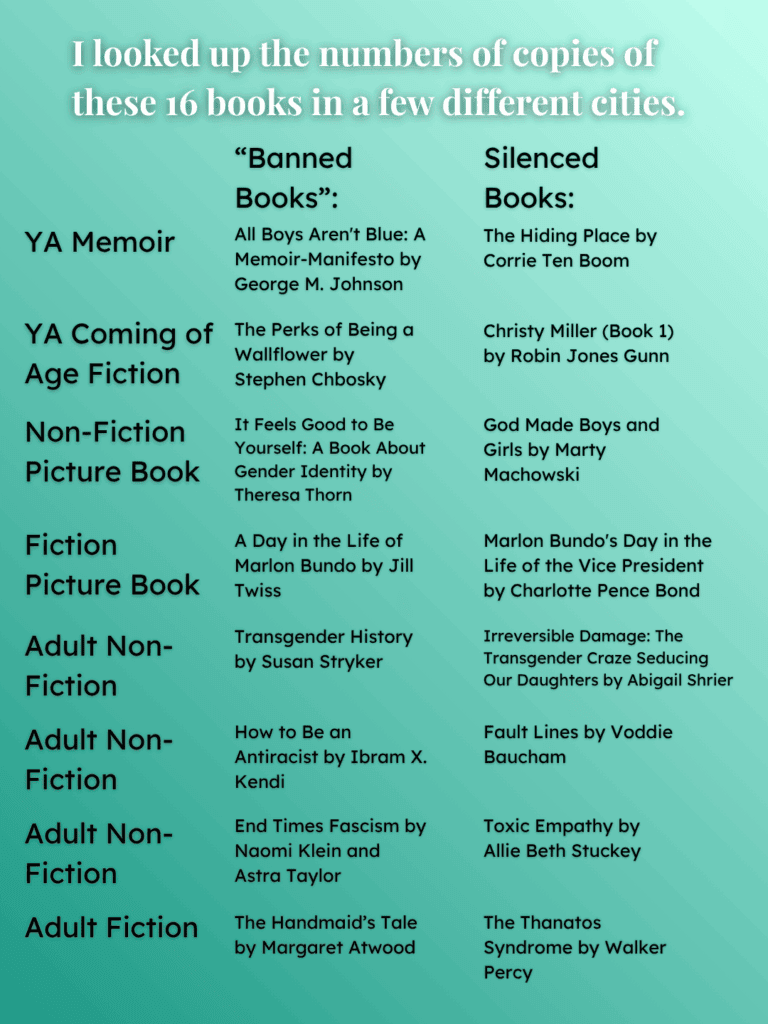
What did I find when I checked large and small, liberal and conservative systems? Even I was surprised.
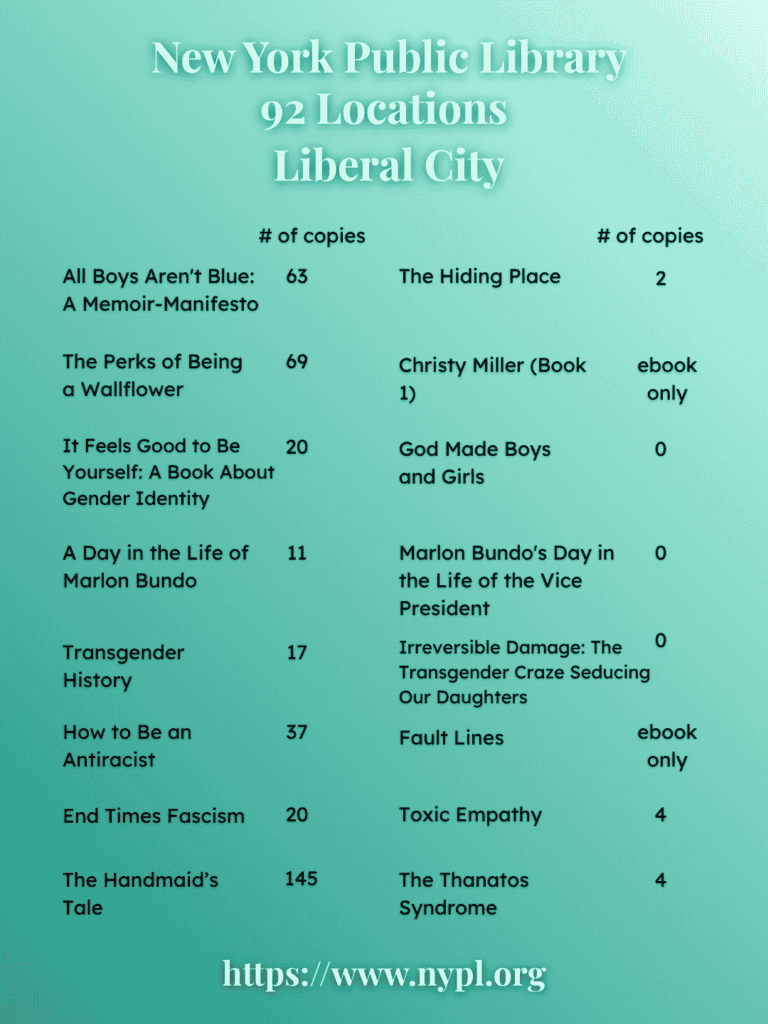
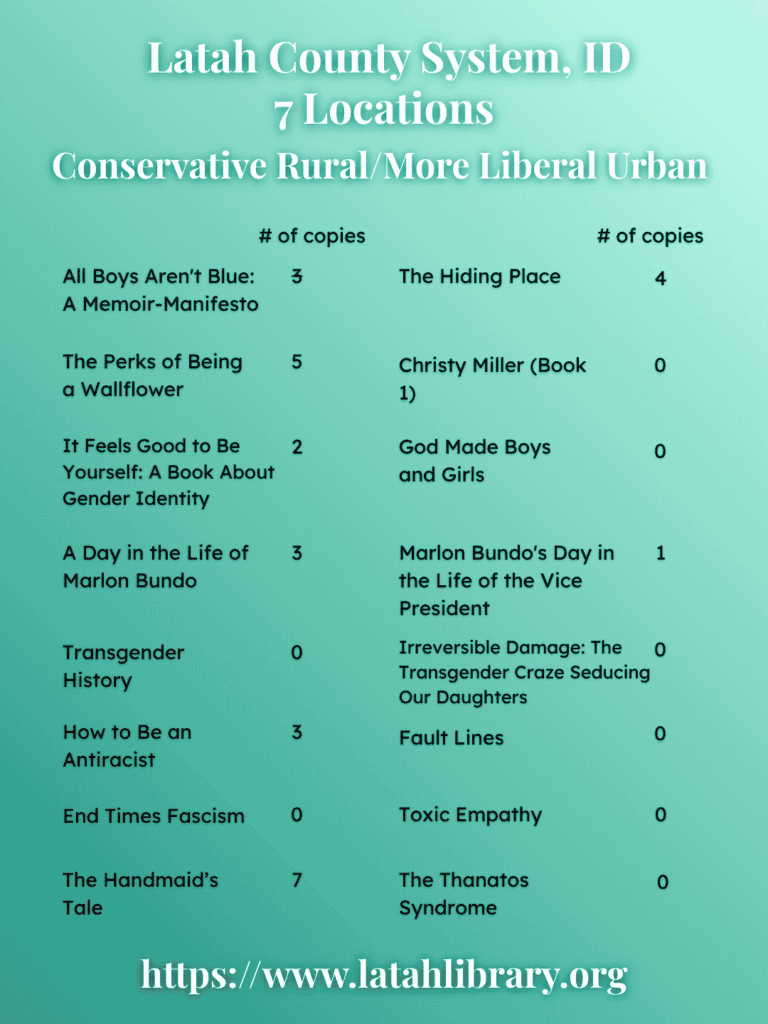
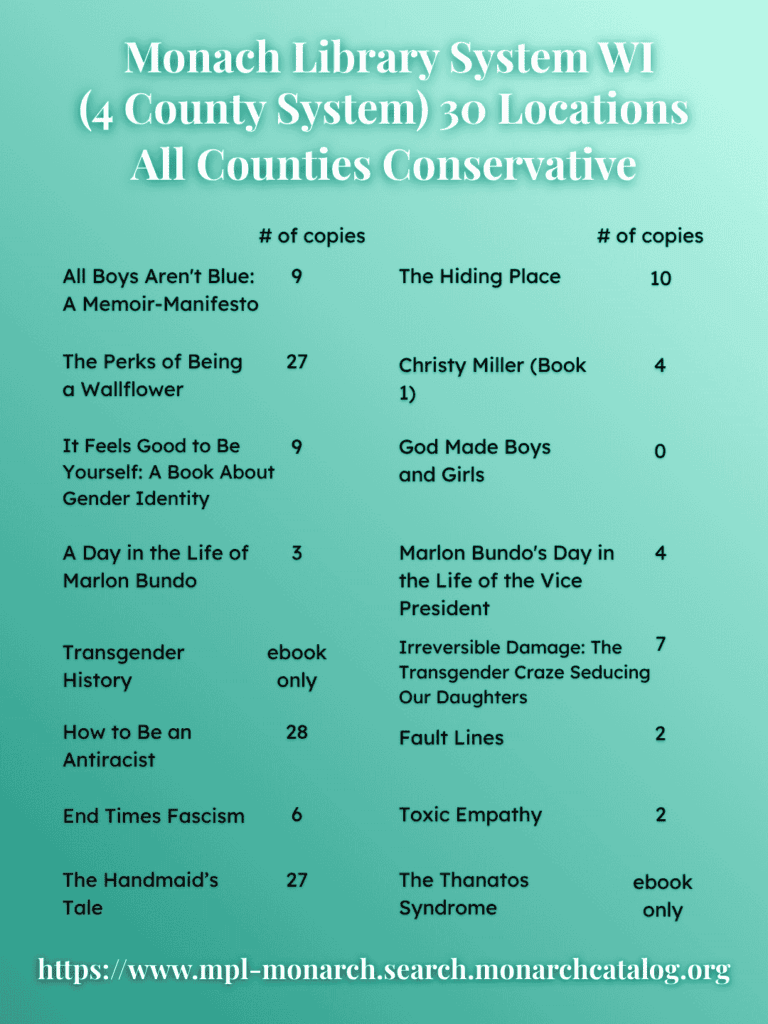
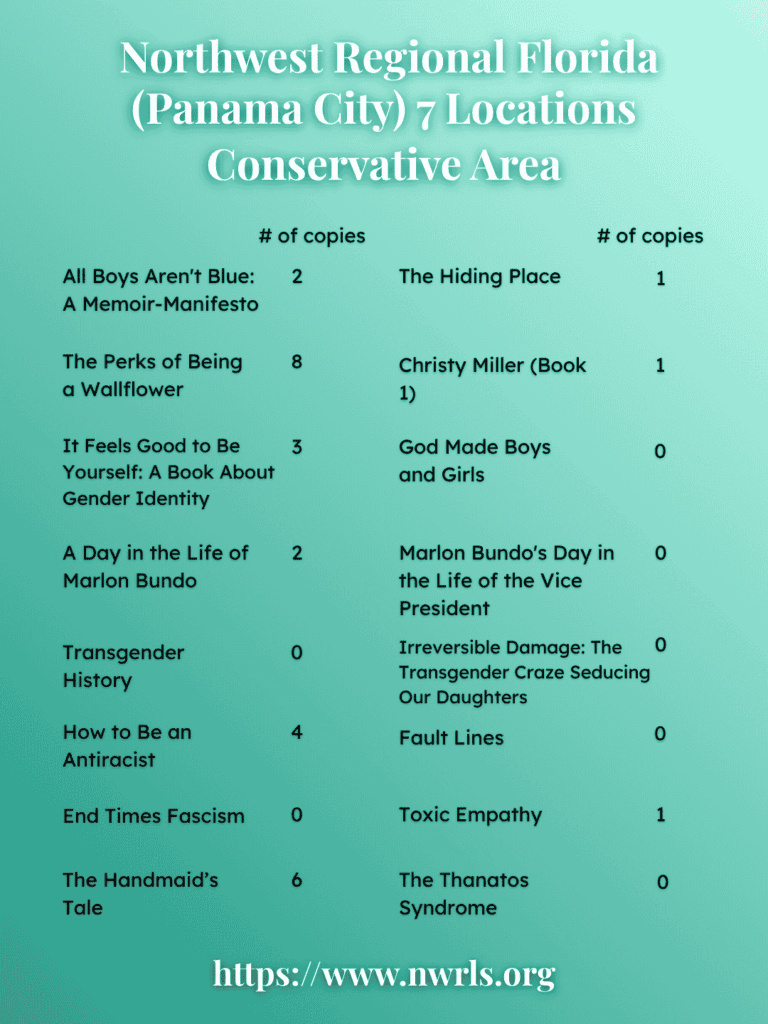
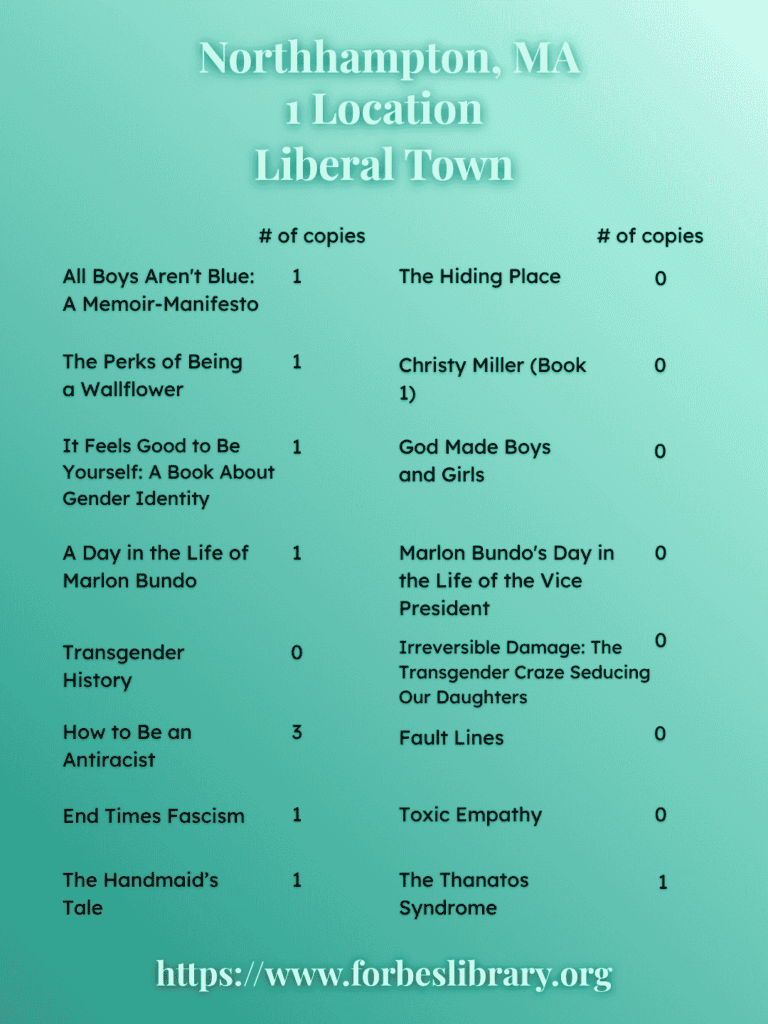
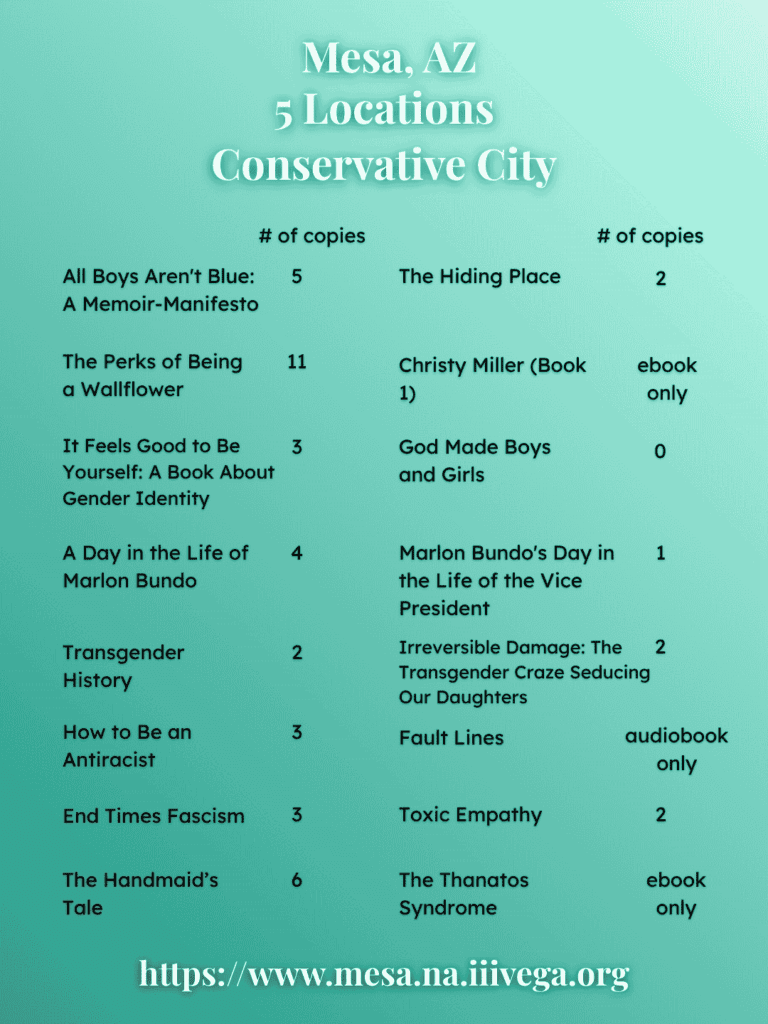
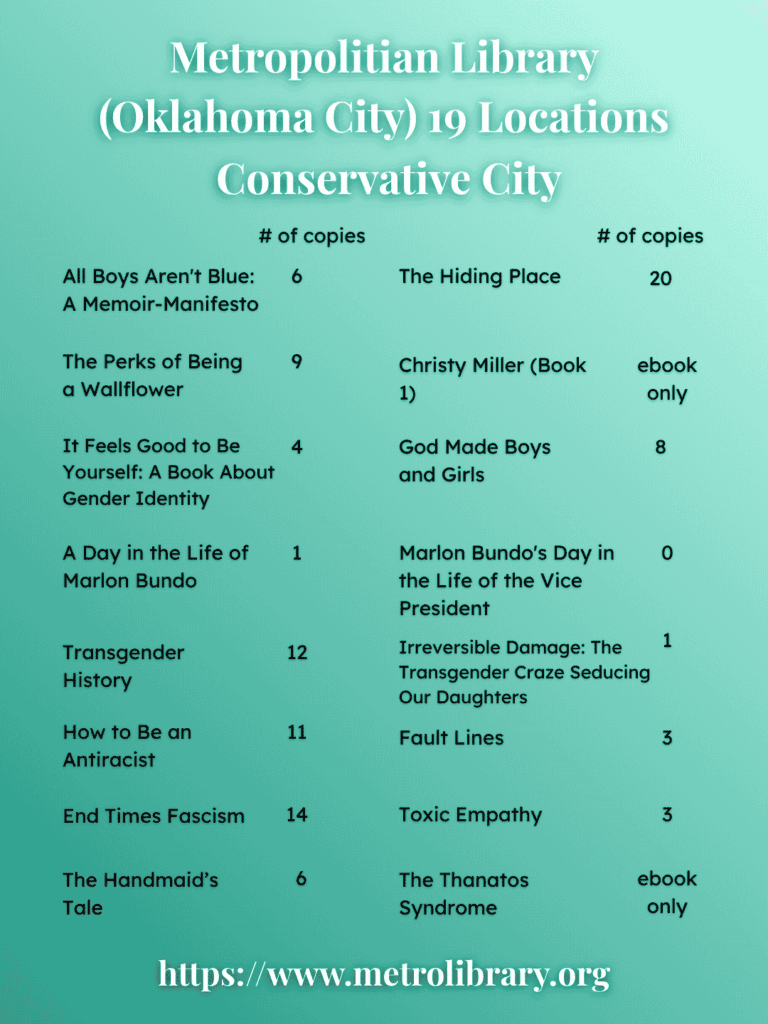
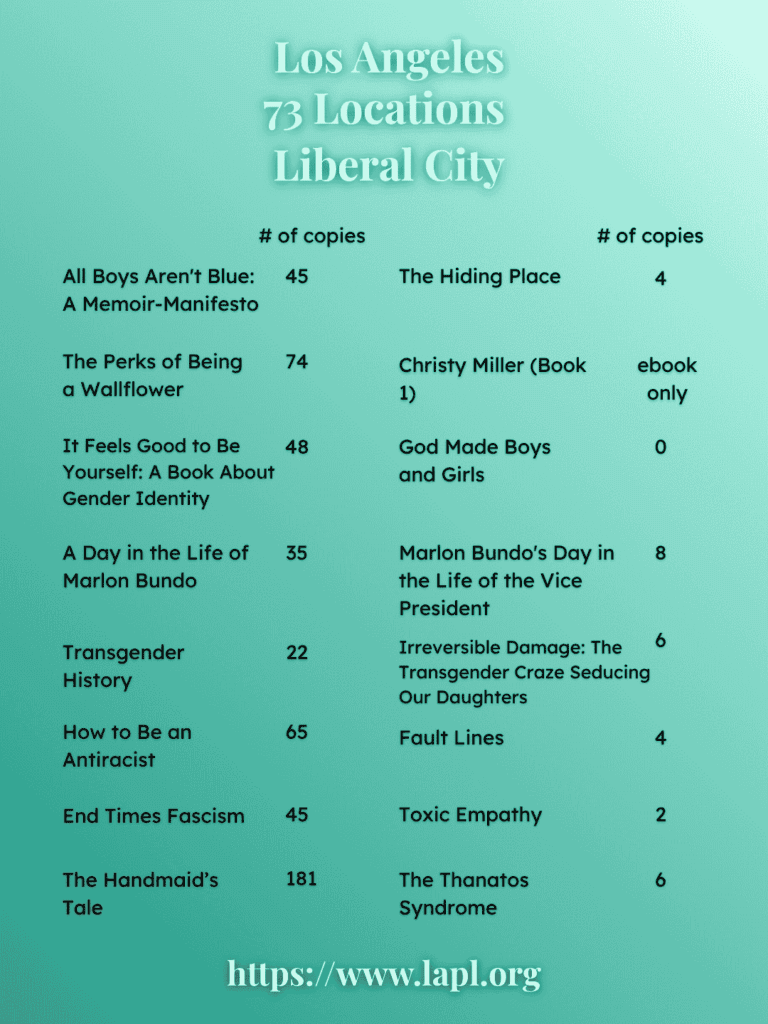
I realize this is only a tiny sampling of books. It also doesn’t take into consideration if other similar books are on the shelf. For example, in all of the systems that had zero copies of Transgender History, they had other similar titles. This also doesn’t take into consideration the number of titles in a certain genre/topic. For example, a liberal system might have many LGBTQ picture books and a conservative system might have many Christian ones.
Demand also plays a part, meaning we should expect more copies of a highly sought after title, however this is a major place where we see a discrepancy: best sellers with liberal ideologies far outnumber best sellers with conservative ones. The idea of a liberal demographic of books being banned simply isn’t true. “Banned Books” are often the most easily accessible in public libaries.
The fight for Silenced Books, however, shouldn’t be silent.
Check your public library’s system to see the balance firsthand. If you are unhappy, respectfully and without accusation, talk to your librarians. Books can’t be “Banned” if they are rarely or never purchased. Let Silenced Books be heard.