

Summary
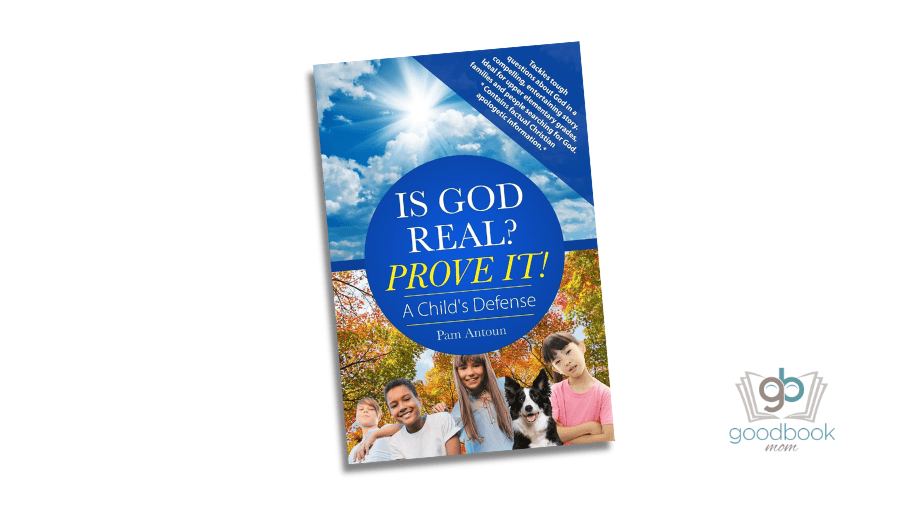
During school, Amanda and Josiah become friends with Gavin and Sophia. Gavin is vehemently against God and asks a lot of challenging questions. Sophia is also skeptical of God’s existence and fuels the conversation. Amanda and Josiah try to answer their friends and make a case for the existence of God, Biblical reliability, the resurrection of Jesus, and many other topics. The book is written in a nine-chapter book format and follows a plot, integrating apologetics into the story. The book contains end of chapter questions for the reader, a glossary, and an end of book answer key to the chapter questions.
Reading Level: 7-10 years old
Read Aloud: 6+ years old
Mom Thoughts
There are not many chapter books that dialogue in an apologetics fashion. I loved the idea of this book and the author’s heart behind it stated in the introduction. I enjoyed the questions at the end of the chapter for the reader to work though. I also liked the text blurbs with more defined definitions and facts. The main characters also had a strong reliance on prayer throughout the conversations.
However, there were issues with this book. Minor issues included inconsistent chapter length, minimal Scripture in the dialogue, and pushing kids to have their spiritual gifts assessed using online websites. For this age group, the richness of content is too low. Kids can understand deeper truths, and this book needed to dive further into theology basics, rather than “dumbing down” words like sin (bad choices), righteousness (good choices), and hell (evil, painful place). Moderate issues became theological pitfalls. For instance, the Trinity is defined as three “individuals,” rather than three persons. Left as is with no further explanation, it is heterodox at minimum. Sin was conflated and defined as bad choices, and forgiveness was defined as the release from punishment of bad choices. The medium of salvation is a sinner’s prayer as modeled by characters, not Romans 10:9 or any Scripture. God’s wrath and justice are severely downplayed throughout the book. When the moral law is discussed, only the 10 commandments are used as God’s standard of righteousness. In the introduction, it is stated, “[God] loves you despite any bad choices you’ve made.” This is an incomplete statement. He in no way loves the unrepentant sinner at enmity with Him in a salvific sense. Also, “Did you know God loves you and doesn’t want to hurt you? He wants a relationship with every person.” This could get into issues with views of atonement.
As far as major issues, I will categorize them and provide examples. The first category is man-centric Gospel in initiation of salvation and its effects. Throughout the whole book, the characters urge one another to choose God. “The reason God created us is because He loves us, and wants us to freely choose to love Him back.” It in no way talks of God’s glory, God’s work in salvation, or God to be praised for the saving. “After you start a relationship with God, what do you do next?” “We need to get through the wall of sin to become friends with God.” There are countless examples of this, and these are given no context other than man at work. Additionally, when evangelism is discussed, the responsibility lies on man – not God’s drawing or the Holy Spirit’s work. “After having a relationship with God you will learn to love yourself better…” This is false! We learn to mortify our sin and hate the indwelling sin that lost its power but not its presence. “He must be greater; I must be less.” The preeminent goal constantly stated is to become “friends with God.” The relationship between God and man is relegated only to friend status. It does not explain Jesus as Potentate, Sovereign, Master, Lord, and how we should be in submission to Him. While we do go from enemies to friends, the entire relationship cannot be limited to just that descriptor. Lastly, page 112 in the answer section, without further clarification, seems semi-pelagian. I do not use that term loosely or as a slight to anything outside of the Reformed belief system. The actual text implies we retain some original goodness to make good choices unto salvation apart from Christ’s regenerative work.
Second, sin or “bad choices” are completely diminished to an unbiblical level. “God loves everyone and wants each person to choose to love Him back. God gives us freedom to make good choices. Bad decisions, sometimes our own and sometimes others, hurt us, not God.” Sin is primarily a grievance against a holy God, so this is untrue. “Having a relationship with God has made me and millions of people more comfortable with life. I still have fun like before. I just feel more peace now. Trouble happens when we or others disobey God.” This is equating sin with fun and you can live how you did; you just have peace until you disobey. It is a weak statement which can lead to a total misunderstanding of free grace.
Third, there are incorrect statements like, “God promises He won’t give us more than we can handle,” and God speaking in quiet whispers. The egg analogy for the Trinity is used, which is heretical. An egg is made of 3 different substances, while the Father, Son and Spirit are all the same substance or essence (homoousios – see Council of Nicea AD 325).
Finally, there is one chapter with a poor apologetic argument. “Since millions of people feel God’s love and insist their lives were changed through their relationship with God’s Son, Jesus, no one can prove God isn’t real…There are times when God makes me feel warm and happy inside, just like warm hot chocolate. God wants to be every person’s best friend.” The cult of Mormonism strongly relies on feeling God, “the burning in the bosom,” as do other world religions. Who is to say your feeling of God isn’t the god of Buddhists, Hindus, or Muslims? Since this argument relies on subjectivity, it cannot stand. No one can prove God isn’t real based on a feeling; it is not a coherent argument.
For these reasons, I cannot recommend the book as a theologically solid resource for young children.
Language:
Namecalling: goofball
Questionable Behaviors:
Gavin eye rolls x4; Gavin is mad at God because his parents divorced
This review is written by Good Book Mom contributor, Emily Russell. To learn more about Emily, click HERE.
At A Glance
| Number of Pages | Number of Chapters |
|---|---|
| 144 | 9 |