
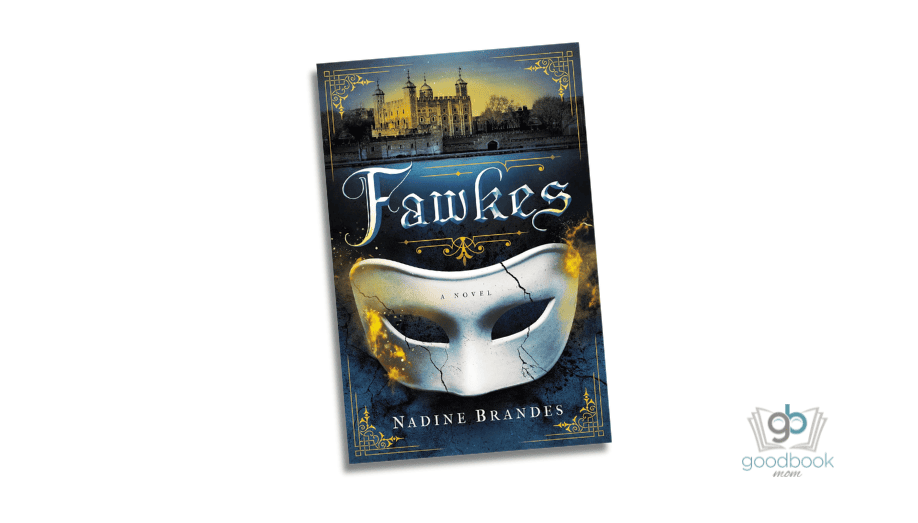

Summary
Thomas Fawkes, son of the infamous Guy Fawkes, prepares for the most important rite of passage of his young life: receive his mask from his father, pass his Color Test, and receive his color magic. Thomas’ desperate hope is that he will be given command over Grey so that he can remove the Stone Plague that afflicts his body and distorts his face. But when the fateful day arrives, Guy Fawkes never shows up for his son.
Thomas sets out for London to confront his father and demand his mask and his color powers. Upon encountering him, Thomas discovers his father’s involvement in a dangerous plot to kill King James and the members of Parliament. To prove himself to his father and to persuade him to give him his mask, Thomas joins the assassination plot. But he cannot seem to fully silence his own doubts and apprehensions about his father’s plans, even as he worries about his plague spreading in his body.
In the world of Fawkes, the Keepers and the Igniters are at war. Keepers like Guy Fawkes and his crew are bonded to one color only and wield telekinetic power over that color (for example, Blue power lends control over water; Green offers power over plants and herbal remedies). However, the Igniters (like King James and his supporters) want to use White Light to control all colors, as White is the source of all of the colors. The White Light is unique in that it cannot be controlled, manipulated, or commanded; White Light communicates as a person inside one’s mind and spirit.
Throughout the story, Thomas seeks to discern what are good and honorable choices for him as a young man (particularly with regard to his father’s assassination plot), and he is also on a quest to discover the source of truth. Are Keepers correct in labeling all Igniters as greedy and violent? Or have the actions of a few Igniters wrongly tainted his view of White Light?
Reading Level: Ages 14-18
Read-aloud Age: 14+
Mom Thoughts
Fawkes cleverly blends historical fiction with fantasy in this exploration of the world around the Gunpowder Plot of 1605. Your history lovers and Anglophiles will have a lot of fun diving into this historical event, or if your reader isn’t already familiar with this slice of history, the book will provide an entertaining introduction. Brandes grounds the story in actual documented events (be sure to read the Author’s Note!) as well as name-checks some of the era’s most prominent characters (King James, William Shakespeare, Ben Jonson, John Hawkins, and notably, the infamous John Dee serving as the story’s villain.)
There is a fantastic subplot involving Thomas’ school friend Emma Areben, ward of the Baron Monteagle. Emma is a heroine of strength and kindness. Emma accepts Thomas despite his plague, and Thomas becomes a champion for Emma in turn.
In addition to the historical and fantasy plot elements, Brandes makes the interesting choice to set up her story as an allegory of Christian church history. In Brandes’ world, Keepers represent the Catholics of the early 1600s, seeking to overthrow the persecution of the Igniters, stand-ins for the Protestants. Keepers viewed themselves as “[protectors of] the language of the White Light for twelve centuries.” In the Keepers’ view, “the White Light is not for the common man to explore.” Much of the first half of the book is sympathetic to the Keepers’ cause against Igniters, but in the second half of the story, Brandes presents a more nuanced perspective that both Keepers and Igniters have wronged one another. By the end, Thomas understands that he had misjudged Igniters and the White Light. He experiences White Light for himself and embraces it fully, alongside Emma.
One aspect of the book that will turn off some readers is the depiction of White Light. Thomas begins to hear the ‘voice’ of White Light speaking to him, and because of the allegorical underpinnings, the White Light is meant to represent the voice of God. White Light’s ‘voice’ is not what you’d expect from God. Yes, it is sometimes authoritative and at other times gentle, but it is also playful and a bit snarky. Some readers may enjoy this unconventional take; others will find the voice off-putting and call it irreverent.
Language:
Coarse Talk: ‘Home sweet hell’ (uttered by a prisoner); one character calls another off-screen character a ‘wench’ and another called a ‘street trull’; a man refers to a woman as a ‘morsel’; mention of ‘whorehouses’. One brief mention of ‘forcing yourself on someone’ and ‘castrating someone.’ Thomas frequently thinks ‘Blast it’ or ‘Blast it all’ or ‘Curse this plague!’
Name-calling: Percy refers to Scotsmen as ‘those Northern pigs’. (Throughout the story, many characters express prejudicial views toward other people groups, e.g. the ‘Keepers’ views about the ‘Igniters’ and vice versa. The human inclination to make unfair or ignorant judgments of others comprises a major theme of the book).
Questionable Behaviors:
Standard adventure-tale violence. The Gunpowder Plot of 1605 is the central historical event of the story, which was a plot to assassinate King James and members of English Parliament.
Brief and non-explicit scenes that include hangings, stabbings, gunshots, and sword fights. Mention of heads on spikes outside the Tower of London. One non-descriptive scene where a group of prisoners drown in the Thames River. Thomas attempts to extract parts of the stone plague from his shoulder by cutting it out with a knife.
Sexual Content:
One brief kiss between Thomas and Emma. Thomas observes a woman sneaking away in a garden with her “carnal lover” close behind. Thomas seems displeased and indeed wishes to stay near Emma to protect her honor and vulnerability.
Other Things to Know:
The book’s action takes place in early 17th century London, and Brandes does not shy away from true to life descriptions of the filth and grime of the city in an era that pre-dated modern hygienic practices. This includes ale drinking (since the water sources were not safe). Also, in keeping with city life, the book includes brief and non-descriptive mentions of ‘raucous reveling’ in the tavern and ‘intoxicated’ or ‘drunk’ patrons. The behavior is deemed not respectable.
This review was written by Good Book Mom contributor, Nancy. To find out more about Nancy, click HERE.
This post may contain affiliate links. Please read our disclaimer for more info.
Buy This Book
At A Glance
| Number of Pages | Number of Chapters |
|---|---|
| 488 | 49 |