

Summary
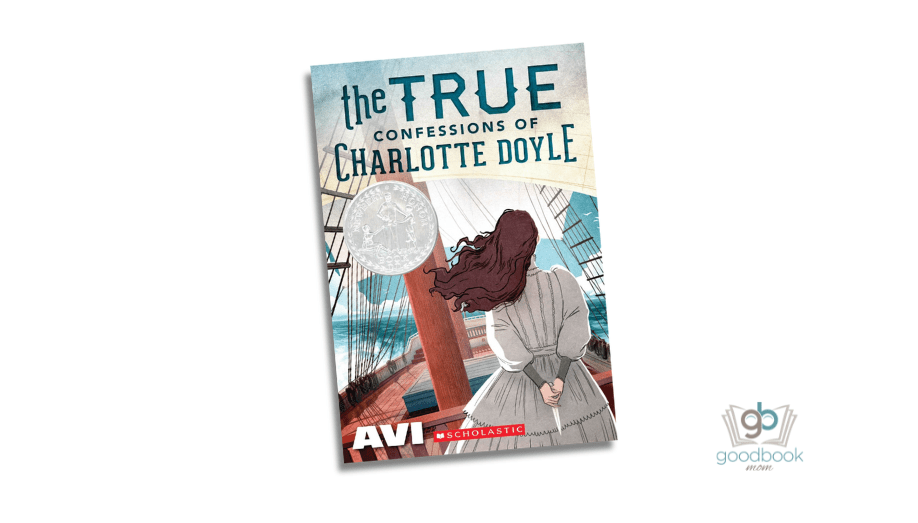
A Newberry Honor Book, The True Confessions of Charlotte Doyle is written as the survivor’s account of the eponymous heroine. The year is 1832, and thirteen-year-old Charlotte travels by ship to rejoin her wealthy family in America after attending boarding school in England. As the only female aboard the ship, Charlotte is relieved to meet Captain Jaggery, a gentleman whose piety and refined manners set him apart from the sailors. Jaggery promises Charlotte his protection and asks her to be his eyes and ears amongst the crew.
During the tumultuous voyage across the Atlantic, a man is murdered, and Charlotte is accused, tried, and found guilty of his murder. In this harrowing tale, Charlotte transforms from a pampered, naïve member of the upper class into a savvy and courageous mutineer.
Reading Level: Ages 10-13
Read Aloud: Ages 10-13
Mom Thoughts
The True Confessions of Charlotte Doyle is a thrilling tale with undisputable literary quality and plentiful historical details concerning the design and workings of a nineteenth-century ship. It is not, however, a title that I would include in my family library due to its negative depictions of Christianity and the nuclear family.
Captain Jaggery and Charlotte’s father are parallel patriarchal archetypes. Jaggery uses the Bible to bully and oppress his crew while he exalts himself to a godlike position. Charlotte’s father is similarly tyrannical, and both men are consumed by greed and the pursuit of status. Likewise, both men view Charlotte’s freedom as contrary to the “natural order.”
Charlotte is a feminist archetype. Charlotte narrates, “I certainly wanted to be a lady. It was not just my ambition; it was my destiny. I embraced it wholly, gladly, with not an untoward thought of anything else…during my life I had never once – not for a moment – been without the support, the guidance, the protection of my elders.” At the start of the story, Charlotte is vain, foolish, elitist, moralistic, and self-righteous. Nevertheless, Zechariah, a humble, elderly, pagan, black man, recognizes that Charlotte’s faults are merely the effect of her family and her upbringing. He sees Charlotte’s true, inner goodness, describing her as the “very soul of justice.” Charlotte’s inner goodness comes to light when Charlotte casts off patriarchal authority.
Abundant religious imagery adorns this secular title with references to Jonah, the devil, the final judgement, and tormented souls in hell. God is portrayed as the angry avenger of the oppressed, and the crude, unchurched sailors are portrayed as the truly moral people.
When Charlotte is reunited with her family, she is met with cold indifference. Charlotte’s mother cares only for appearances and meekly acquiesces to Charlotte’s father in all things. Charlotte’s younger brother and sister notice only Charlotte’s dirty clothes and tanned skin. When Charlotte escapes her family and rejoins the crew, she tells Zechariah, “I’ve decided to come home.”
Language:
The story frequently mentions the sailors cursing and swearing oaths but, for the most part, the story does not contain specific profanity. In one instance, Jaggery yells, “Damn you!” to his crew. Hell is referenced with the sailors being described as “like men recruited from the doormat of Hell” and with Jaggery telling one of the men, “I wondered where you’d gone. Not to hell as I’d hoped.” The expletive “bloody” is used twice, and a sailor uses the phrase “God’s fist” as an expletive on one occasion. After Charlotte insults Jaggery, he screams that she is a “sniffling, self-centered, ugly, contemptible girl who deserves a horsewhipping!” Charlotte calls Jaggery a fraud and a coward.
Questionable Behaviors:
Although not described in graphic detail, the story contains a significant amount of violence. Two men are murdered. Another is beaten almost to the point of death, with beatings being the primary form of punishment onboard the ship. Charlotte also lies on several occasions.
Sexual Content:
When meeting Captain Jaggery for the first time, Charlotte gathered “all my womanly arts so as to present myself in the most agreeable fashion, making sure my hair, my best asset, fell just so – despite the breeze- to my lower back.” Later, Charlotte is flattered that both Jaggery and Zechariah are “courting” her friendship. After Charlotte rebels against Jaggery, he snarls, “Let them [the crew] take care of you in any way they want. I withdraw my protection.”
Hanging on the walls of the crew’s quarters are “pictures of a scandalous nature.” Charlotte describes one sailor as “a young, blond Scot – handsome, I thought – with a shocking tattoo of a mermaid upon his arm.” That sailor loves to tell Charlotte about his Aberdeen sweetheart, and Charlotte comes to understand that the mermaid and the sweetheart are one and the same. Upon their parting ways at the end of the story, this same sailor kisses Charlotte’s cheeks and tells her, “You’re my mermaid now, lass.”
There is also friendly hugging and handholding between Charlotte and the crew that isn’t supposed to be romantic but, given that Charlotte is thirteen and the crew is composed of adult men, these platonic displays of affection seem inappropriate, nevertheless.
Other Things to Know:
The story contains brief references to the dead coming back as either angels or ghosts. Zechariah, being black, faces “much cruel humor” from the other crew members, even as the crew ultimately displays tremendous loyalty towards him. When Zechariah suggests bringing Jaggery to justice in criminal court, Charlotte responds, “A black man, a common sailor, testifying against a white officer…” She didn’t have the heart to finish.
This review is written by Good Book Mom contributor, Katherine. To learn more about Katherine, click HERE.
This post may contain affiliate links. Please read our disclaimer for more info.
Buy This Book
At A Glance
| Number of Pages | Number of Chapters |
|---|---|
| 210 | 22 |