
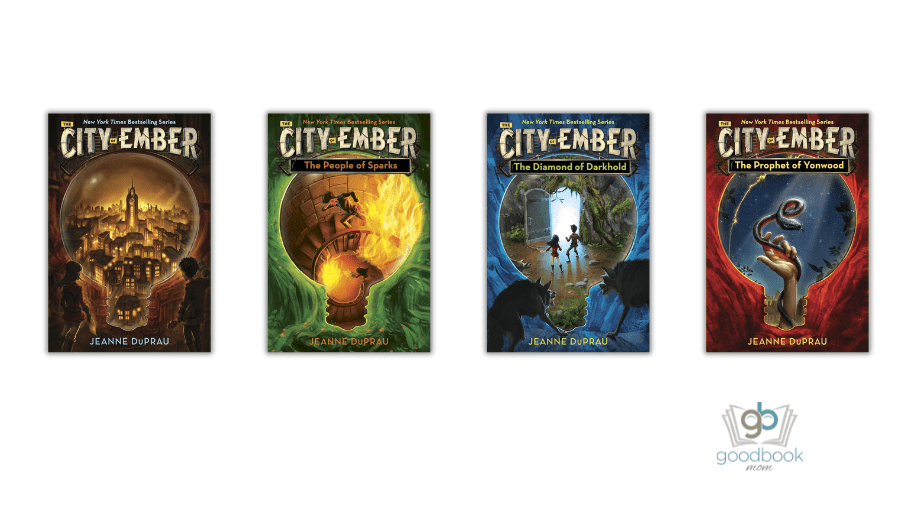

Summary
A city built amid complete darkness. The only light an amber glow from the few remaining flood lights in the streets and the flickering light bulbs in the homes of the residents. The electricity is failing and food is running scarce. Is there any hope of saving the city and the people in it? Twelve-year-olds Doon, a hot head learning to control his anger, and Lina, an orphan caring for her baby sister and aging grandmother, make a mysterious discovery, a protected message partially destroyed. In trying to decipher the message, they explore the underground tunnels of the town and unearth some harrowing truths about those leading the people. This leaves the kids on their own to save the people of Ember.
Reading Level: 9-11
Read Aloud Age: 8+
Mom Thoughts
As a favorite childhood book (book one), I was happy to revisit this story and read it through the eyes of a discerning parent. This book was the beginning of a love for fantasy and dystopian reads and I’m excited to pass it on to my own children. The City of Ember would make a wonderful first “long” chapter book for a budding reader. The book is written in very simple, clear language and is easy to comprehend. It is filled with adventure and thrills that will delight boys and girls alike.
Unfortunately, I found that book one was the only book worth reading in this series. I found calling The Prophet of Yonwood a prequel to The City of Ember to be a stretch. These are whole new characters, cities, circumstances. The only connection is on the very last page of the book. It left me with none of the answers or the story line I was hoping for, such as the beginnings of the city. I would be cautious in handing these books to a younger child who may not understand the conflict and have enough wisdom to discern the behavior of the characters.
My other apprehension is the presentation of a group of people called the “Believers”. They play a small role, being mentioned just a handful of times and not with much description but are worth mentioning. The “Believers” think someone is coming to save them from their plight and are often found gathering and singing about their hope in this salvation. Nothing ever comes from this belief and the people are not saved. Instead, Doon and Lina find “The Instructions” that lead them out of the city and allow them to essentially save themselves.
In summary, I cannot recommend entire series to fellow believers. The first book, The City of Ember was enjoyable, but because of severe problems with others in the series (see below), I would recommend that families stop after the initial book.
Language:
The mayor is often described as “fat,” or “a great blob of a person” and the characters speak of his “fat stomach.” (Book 1)
Describes someone as having a “wide rear end.” (Book 2)
Words used to describe the people of Sparks, “ignorant brutes,” “moron,” “stupid barbarian” (Book 2)
Caspar, the roamer, is described as “out of his mind” (Book 2)
“plump woman,” “stupid,” “weirdo,” “not exactly fat,” “moron,” “sluttish,” “queer.” (Book 4)
Questionable Behaviors:
A child is disrespectful to an adult, but one could say it is for a good reason. (Book 1)
On each side of the conflict, there is a singular person who personifies the extreme attitudes of each group. Therefore, they each have an abundance of questionable behaviors, but these behaviors are shown to be a problem and wrong. (Book 2)
Torren, a young Spark villager, is selfish, lies, has many hateful thoughts, rude comments, he ruins property and then frames an Emberite for his actions. Perhaps the most concerning behavior of Torren is fantasizing about bombing the people of Ember (Book 2).
Tick is a self-appointed leader of Ember. He intentionally hurts people and destroys property and then frames the people of Sparks for his actions. Tick also encourages violence and makes weapons for the Emberites to use. (Book 2)
Lina runs off with people she hardly knows without telling her guardian. (Book 2)
Caspar, Torren’s older, roamer brother, also displays rude and violent behavior. He refuses to help a man in need. (Book 2)
“You are being dumb.” (Book 3)
Lying about being late to school (Book 4)
“Dancing around naked” (Book 4)
Character thinks about pushing a girl down the stairs, choking her (Book 4)
Sexual Content:
A character mentions she has a boyfriend, but no interaction between them is described. (Book 1)
“girlfriend” (Book 3)
Talk of 13-year-olds running off together to make a home, no romantic relationship is mentioned (Book 3)
Eleven-year-old has a goal to fall in love, “to have the experience of being madly, passionately in love” (Book 4)
Covers of romance novels describes (Book 4)
Grandma asks if a friend is his “girlfriend” (Book 4)
Excerpts from fictional romance novels, nothing graphic, but I question the appropriateness for the intended audience (Book 4)
Two adults kiss (Book 4)
Other Things to Know:
The book included death of parents and an aging grandparent develops dementia and eventually dies. (Book 1)
A distraught, hurt man acts irrationally. (Book 1)
An intense description of the “darkness… inside us.”(Book 1)
A quick, vague scene of people drowning. (Book 2)
Lina questions if she possess magic or precognitive abilities. (Book 2)
Planning for a violent attack. (Book 2)
A comment about the meaning of life, not necessarily untrue, but may be worth prereading and discussing. (Book 2)
A machine gun (not stated explicitly but matches the description) fired at a group of people, but misses, firing above their heads and then explodes. (Book 2)
Mentions illness, death, a toddler drowning (Book 3)
A mention of the possibility of finding dead bodies (Book 3)
Alludes to people falling in a pit and dying, and then the finding of their bones (Book 3)
Discusses people dying from being trampled and then having to remove their bodies (Book 3)
“A god is the most powerful person there is. A god can rule an entire city, or an entire world. A god has riches, including jewels. So.” A quote from the antagonist in the book, referring to himself. (Book 3)
A mention of ghost, but no actual ghost in the story (Book 3)
The varying examples of legalism and asceticism are throughout the book, as well as the portrayal of the “church” as a kind of cult (this word is not used, just my own assessment of the actions described). (Book 4)
A woman has a vision, says “It’s God,” the people of the town call her “the Prophet” (Book 4)
The church changes its name to “The Church of the Fiery Vision” (Book 4)
Nickie’s Aunt was married twice, now there is no one (Book 4)
“spirits” (Book 4)
“people have strayed From God’s way, so that’s why everything is so awful and heading for doom. But God wants to save us so he gave the vision to Althea it. If we do right, we’ll be saved…” “it’s God’s orders coming through her.” (Book 4)
“ There’s a lot of people in the world right now who want to hurt us period the forces of evil are strong. But our country is standing up against them, and here in Yonwood we are, too.” (Book 4)
Comments about “sinners” not in agreeance with the biblical definition (Book 4)
Comments about “God’s works” and what it means to “be a holy person” that are not biblical (Book 4)
“ghost” (Book 4)
“aliens and demons” (Book 4)
Aunt has no interest in talking about God, “It’s too deep for me.” (Book 4)
A conversation between the main character and her aunt dismiss the true definition of sin and the existence of God, “Hurts God? How can God be hurt?” “Well, I mean if what you do goes against what God says.” “You’d have to know what he says, then, wouldn’t you? Assuming he’s up there saying anything.” (Book 4)
“When you have faith that you’re right – you know it from the bottom of your soul – you’re willing to do anything for it.” (Book 4)
“Love is love, seems to me, as long as what you love isn’t an armed robbery, or bombing airplanes, or kidnapping little children.” (Book 4)
“Nikki could only think that either there were lots of different God’s all saying different things to different people, or that God didn’t really speak to people at all, or the people thought they were hearing God speak when really they were hearing something else.” (Book 4)
“Only not for the prophet’s God, her mean, picky God who dislikes so many things. It’s for my God the God of dogs and snakes…” (Book 4)
This review is written by Good Book Mom contributor, Rachel Horn. To learn more about Rachel, click HERE.
This post may contain affiliate links. Please read our disclaimer for more info.
Buy This Book
At A Glance
| Number of Books | Number of Pages Each |
|---|---|
| 4 | Around 300 |