

Summary
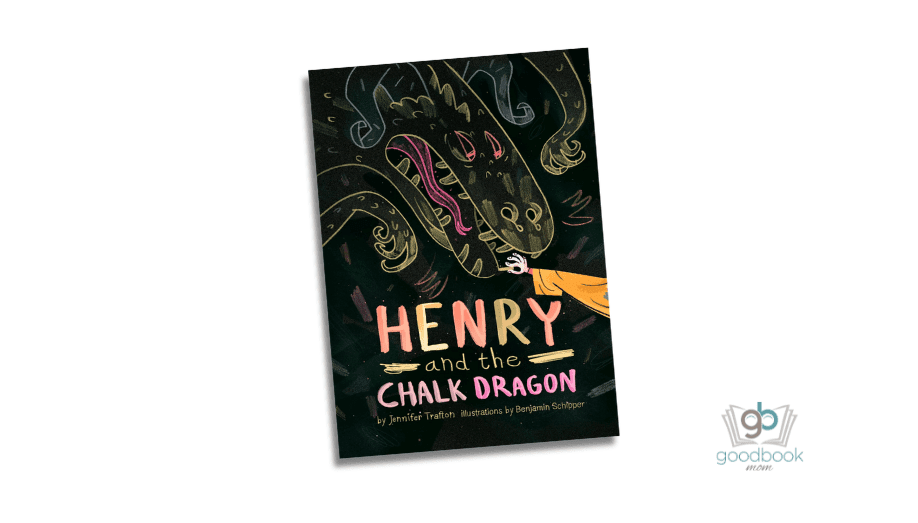
Henry and the Chalk Dragon by Jennifer Trafton tells the story of Henry Penwhistle, a fantastically imaginative, but very shy, student at La Muncha Elementary School. From the safety of his bedroom, Henry’s imagination takes him on epic adventures. Whether Henry is battling pirates or helping Abraham Lincoln defend the Civil War from invading aliens, Henry always wears his armor (an aluminum-foil-covered raincoat with a milk carton helmet) and follows the rules of chivalry (be kind, be brave, be loyal, etc.) Henry records drawings of his heroic feats in a secret notebook and on a chalk board on the back of his bedroom door.
Henry’s wild imagination and eccentric attire puts him at odds with both his classmates and the school’s principal. A boy named Simon Snoot teases Henry and plays pranks on him. Principal Bunk writes a letter to Henry’s parents expressing concern that Henry draws scientifically inaccurate pictures during class. Principal Bunk also speculates that Henry might cause other children to believe things that aren’t true, thereby compromising the school’s test scores.
Try as he might to keep his art to himself, Henry’s private world collides with reality when the chalk dragon from the back of his bedroom door comes to life and escapes into Henry’s school. Accompanied by his best friend, Oscar, Henry sets out to slay the dragon and to save his school from the ensuing chaos. In doing so, Henry battles an even bigger foe, his self-consciousness. Henry summons his bravery and unites with his classmates to defeat the dragon, transforming it from a beast into an artistic masterpiece.
Reading level: Ages 8-12
Read aloud age: 6-12
Mom Thoughts
Henry and the Chalk Dragon is a fun and fanciful read that captures the joy of imagination and portrays art as a type of magic. The story weaves in references to a plethora of well-known children’s stories and draws inspiration from the classic Don Quixote. I chuckled at Trafton’s description of Henry in his homemade armor leaping around his bedroom fending off an imaginary dragon with a cardboard gift wrap tube. Henry is a relatable protagonist who struggles with self-consciousness, has an argument with his best friend, and comes into conflict with a rather foolish authority figure. The story is an ode to imagination, but the conflicts contained within the story are very real to childhood.
My objections to this story are the same objections I have with most secular children’s stories. Namely, when Henry faces trials, he overcomes them by looking inward and discovering the good within himself. He musters up his own bravery, loyalty, and kindness rather than discovering that these virtues are the fruit of faith in Christ. While many elementary and middle grade students will relate to Henry’s struggle against self-consciousness, I believe that the antidote to self-consciousness will never be found within us. We overcome self-consciousness when we look to God instead. In the end, Henry reconciles with Oscar, Principal Bunk, Simon Snoot, and the other classmates who teased Henry, but while he extends forgiveness, there is no humility or acknowledgment of wrongdoing on Henry’s part.
Language:
Much of the humor in the book centers around name-calling: milk brain, pig face, blobfish face, skunk face, muttonhead, nincompoop, perambulating lobe-sniffer, trout- snouted putrefied armadillo face. Also featured are less creative insults such as stupid, crazy, weirdo, dumb, ugly, and bonehead.
There are scattered examples of bodily humor. Henry “kicked his legs, spun around, sliced the air with his sword, and landed in a pile of dragon poop – which had once been green socks.” During a lesson on similes, a classmate offers the example, “The sunset is like the sun got a cold and wiped its nose all over the sky.”
Henry describes Simon Snoot as his “mortal enemy” and Principal Bunk as “crazy” and “a supervillain” with a “dastardly plot to enslave the world.”
Questionable Behaviors:
While the interactions between Henry and his parents are favorable overall, at one point, Henry’s mom walks into his room and Henry exclaims, “Mom! You always interrupt!” Henry also contemplates lying to his mother at one point in the story.
Henry expresses suspicion and a general lack of kindness to many of his classmates. When a classmate smiles at Henry, expresses interest in his armor, and asks if she can try on his helmet, Henry’s internal dialogue is, “I’d rather feed you to the dragon.” After Simon Snoot drops a cricket down the back of Henry’s neck, Henry retaliates by holding up a feather duster and spinning the handle “between his two hands so furiously that Simon was covered with dirt and dead flies and spider webs before he even remembered to sneeze.” When Jade (who later becomes Henry’s friend)
wants to join the quest to defeat the dragon, Henry replies, “You can’t be a knight…You’re a girl!” adding under his breath, “Not to mention an alien spy who’s trying to kidnap us.”
Sexual Content:
Henry’s dad teases him about rescuing damsels in distress. There is also a flirtation between the lunch lady and the bus driver in which the bus driver exclaims, “if I made a statue of cinnamon sticks, with eyes of blueberries and cheeks of apple cobbler and golden gumdrops in its hair, and if I loved that statue so much that it turned into a real live person, it would look just like you.”
Other Things to Know:
The authority figures in this book (primarily Principal Bunk, the teachers at La Muncha Elementary, the school board members, and to a lesser degree Henry’s parents) are portrayed as having lost their imaginations, and consequently they remain oblivious to the dragon even as it wreaks havoc and mayhem around them.
The only magic that takes place within the story itself is the chalk dragon coming to life, however there are also scattered references to magic, spells, ghosts, goblins, and vampires.
Most violence or use of weapons in the book takes place within the confines of Henry’s imagination. Henry imagines that a long cardboard tube from a roll of gift wrap is his sword. Henry battles a variety of imaginary foes including pirates, King Kong, and aliens. He wonders if his teacher ever, “rescued a mermaid from a three-headed sea monster by punching it with [her] Incredible Fist of Ice.” The most vivid example of violence within the story is when the chalk dragon eats Oscar, but Oscar frees himself, unharmed, nine pages later. At one point, the lunch lady
pops the dragon on the snout with a frying fan.
Jade overcomes Henry’s and Oscar’s opposition to her joining their quest, helps conquer the rampaging dragon, and goes on to rescue “a whole bus full of boys in distress.”
This review is written by Good Book Mom contributor, Katherine. To learn more about Katherine, click HERE.
This post may contain affiliate links. Please read our disclaimer for more info.
Buy This Book
At A Glance
| Number of Chapters | Number of Pages |
|---|---|
| 18 | 223 |